
The Data Product Lifecycle: From Idea to Impact
Lead the Data Frontier

In the age of modern data-driven organizations, one phrase keeps showing up: data products.
But what does it mean to manage a data product lifecycle?
Just like physical products (phones, apps, or cars), data products go through distinct stages—from creation to retirement. Treating data as a product helps organizations ensure usability, trust, and business value.
Let’s break it down.
🔄 The Data Product Lifecycle
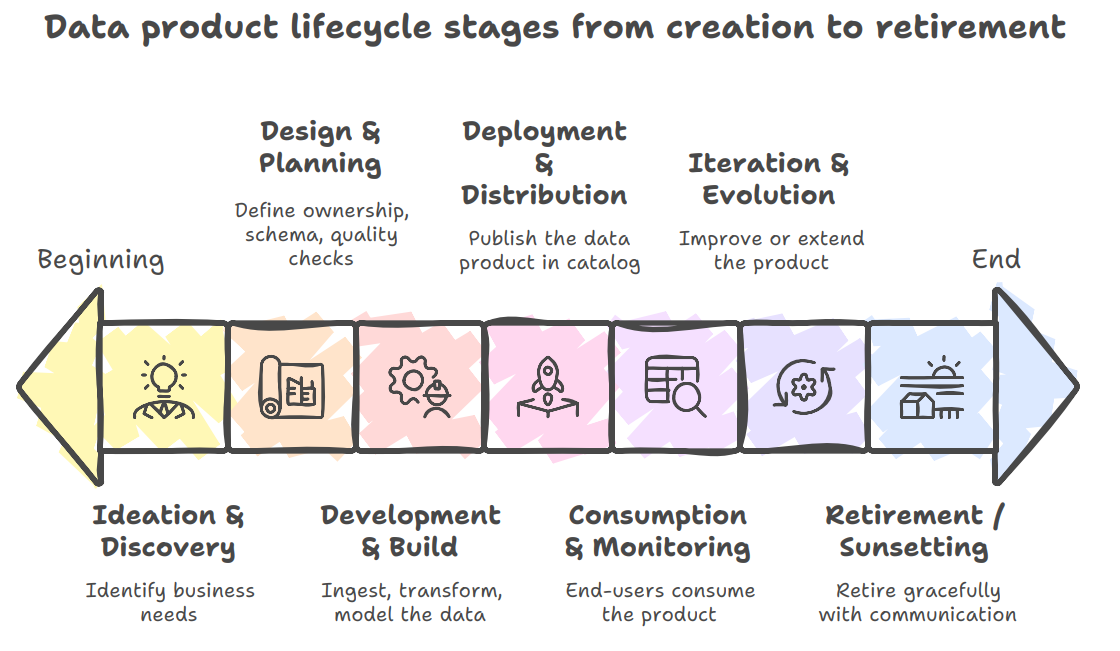
A data product lifecycle is the end-to-end journey of a data product, covering how it is:
Ideation & Discovery
Identify business needs and define the data product.
Example: A marketing team needs a “Customer 360” dataset for personalization.
Design & Planning
Define ownership, schema, quality checks, SLAs, and governance rules.
Treat the data product like an API—clearly specifying inputs, outputs, and usage guidelines.
Development & Build
Ingest, transform, and model the data.
Add observability, lineage, and quality validation (so downstream teams can trust it).
Deployment & Distribution
Publish the data product in a catalog or marketplace.
Ensure discoverability, documentation, and access controls.
Consumption & Monitoring
End-users (analysts, apps, ML models) consume the product.
Monitor performance, quality, adoption, and feedback loops.
Iteration & Evolution
Based on feedback and business changes, improve or extend the product.
E.g., adding new attributes, supporting new regions, or aligning with new compliance requirements.
Retirement / Sunsetting
When a product becomes outdated, it should be retired gracefully with proper communication.
✅ Pros of Managing the Data Product Lifecycle
Clarity & Accountability – Each product has owners, SLAs, and clear contracts.
Improved Trust – Built-in quality checks and governance mean consumers trust the product.
Scalability – Standardized lifecycle management scales across domains.
Business Alignment – Products are tied directly to business needs, not just raw data pipelines.
Reusability – One product can serve multiple teams without rework.
⚠️ Cons and Challenges
Cultural Shift – Moving from “data as pipelines” to “data as products” requires mindset change.
Upfront Investment – Requires governance, cataloging, and product management practices.
Complexity at Scale – Large organizations may struggle with product sprawl and duplication.
Ownership Confusion – Without clear accountability, lifecycle management can break down.
Tooling Gaps – Not all platforms support product-oriented workflows out of the box.
💡 Use Cases of Data Product Lifecycle
Customer 360 Data Product
Lifecycle: Built from multiple systems → published for CRM & marketing → continuously updated.
Sales Forecasting Feature Store
Lifecycle: Features engineered → deployed for ML models → iterated as new variables emerge.
Regulatory Compliance Data Product
Lifecycle: Designed to meet audit requirements → governed and versioned → retired when regulation changes.
Operational Dashboard Dataset
Lifecycle: Developed for real-time visibility → monitored for freshness → evolved with new KPIs.
🚀 Final Thoughts
The data product lifecycle isn’t just a buzzword—it’s a framework that ensures data products are:
discoverable
usable
trustworthy
valuable over time
Organizations that adopt this mindset don’t just manage data—they build a data ecosystem that grows, adapts, and delivers real impact.